Platform deployment
- On-site installation
- SPAN / TAP configuration
- Network integration
- Initial baseline setup
- First 30 days of monitoring, within the agreed scope

OTCOGNISHIELD
No agents. No active discovery scans. Local operation with an authorised passive collection point. Platform pilots are in preparation.
PLUG & PLAY · PASSIVE BY DESIGN
No agents on your production devices. No active discovery scans. No permanent internet connection required.
Connect the appliance to an authorised TAP or switch SPAN feed, with the scope agreed by your IT and engineering teams.
Set the capture interface, confirm the traffic coverage and validate the passive collection arrangement.
Review observed assets, risk priorities and preparation evidence. Keep operation and controlled updates local.
Platform pilots are in preparation. Visibility depends on traffic available at the agreed collection point.
ONE CONNECTED PICTURE
Bring engineering, security, and management together around observed assets, operational risk, and clear next steps.
Where the platform fits: OT, IoT & IIoT architecture · See the topology view →
OTCOGNISHIELD APPLIANCE
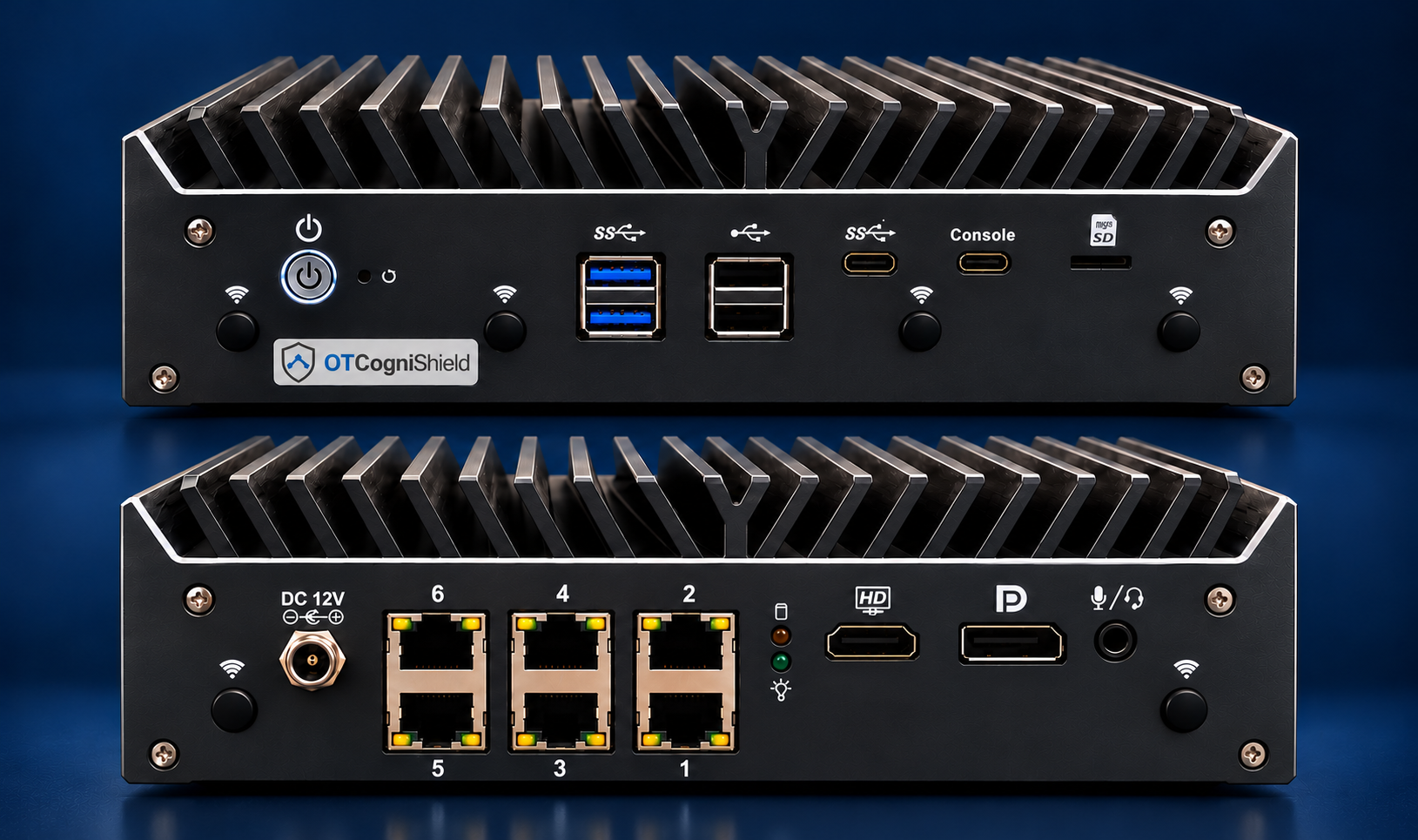
Passive OT, IoT and IIoT visibility from authorised capture data, with offline-capable monitoring and risk intelligence.
Capture points, site coverage and deployment requirements are agreed around your network.
NETWORK & TOPOLOGY
Explore a simplified ICS / SCADA relationship map, with a highlighted review example and clear visibility limits.
Totals from the supplied platform screenshot. Missing links do not establish that an asset is offline.
See the topology view →COMMAND CENTRE
EXAMPLE PRIORITIES
Review access to the production control zone.
Confirm the installed version before planning updates.
Ask the asset owner to validate the observed flow.
OPERATIONAL CONTEXT
Review asset importance, consequences and ownership before deciding what to change.
ASSET DISCOVERY
Bring observed device details, protocols and communication into an inventory your plant team can review.
| Asset | Role | Observed protocol | Assessment scope |
|---|---|---|---|
| PLC — Line 01192.0.2.20 | Process control | Modbus TCP | In scope |
| HMI — Packaging192.0.2.30 | Operator interface | EtherNet/IP | In scope |
| Engineering station192.0.2.40 | Maintenance | OPC UA | In scope |
| Telemetry gateway192.0.2.50 | Sensor aggregation | MQTT | Review required |
Observed details depend on the capture, protocol and available traffic. Your team validates asset identity and scope.
RISK ASSESSMENT
Assess the likelihood and operational consequences, record existing measures, and give the next action a named owner.
Select likelihood and consequence to show a rating.
| Likelihood | 1 Minor | 2 Moderate | 3 Significant | 4 Major |
|---|---|---|---|---|
| 4 Likely | ||||
| 3 Possible | ||||
| 2 Unlikely | ||||
| 1 Rare |
Local assessment bands: Low 1–4 · Medium 5–8 · High 9–12 · Critical 13–16. These are illustrative bands, not an IEC-defined universal scale. Acceptance requires the responsible owner’s decision.
EVIDENCE & REPORTING

OT Security & Risk Intelligence
Assessment evidence
Connect technical findings to scope, consequences, recommendations and evidence. Support conversations with management, auditors and insurers.
Evidence supports review. It does not establish certification or legal compliance by itself.
DEPLOYMENT & INTEGRATION
One-time engagements connect your plant’s architecture, team and evidence requirements to the platform. Platform deployment is currently being prepared through controlled pilots.
Passive at the coreVisibility from authorised OT capture data.
Offline by designKeep production operation independent of the internet.
Evidence you can useBring technical findings into practical decisions.
PRACTICAL SECURITY FOR SMALLER PLANTS
Give your team the context to understand your OT environment and focus on the risks that matter to production.
Use authorised PCAP data or a planned passive capture arrangement. Agree the visibility scope with engineering before collection begins.
Combine asset information and threat scenarios with the consequences that matter to your operation. Prioritise actions your team can review.
Designed for offline and air-gapped production environments, with controlled update packages and a local evidence workflow.
Build visibility and evidence around your plant’s connectivity rules. Agree collection, updates and recovery as part of the pilot.
BEFORE WE TALK
Yes. Consulting services include IEC 62443 assessments, OT architecture design, project delivery and audit preparation. The platform remains in pre-launch validation, with controlled factory pilots and subscription services being prepared separately.
Yes. A combined engagement can include an observed asset inventory, an IEC 62443-3-2 aligned risk assessment, architecture review, readiness report and a scoped platform pilot. Deliverables, fees, access arrangements and readiness are agreed before deployment.
Production operation is designed to work offline, including air-gapped environments. Update delivery and verification should follow an agreed controlled process.
The discovery approach is based on passive visibility and authorised capture data. Collection arrangements and any separately authorised diagnostic activity are agreed before the pilot. The pilot includes review of operational impact.
No tool can establish compliance on its own. OTCogniShield helps organise risk assessment and supporting evidence. Your organisation still needs to determine applicable obligations, review controls and obtain specialist advice or certification where required.
An engineering or operations contact, an agreed scope, and an authorised way to provide relevant capture data. We will agree success criteria, access boundaries and data handling before testing begins.